Introduction: Reimagining the Insurance Response
When catastrophe strikes, businesses face a dual crisis: the immediate operational disruption and the prolonged uncertainty of traditional insurance claims. A manufacturing facility damaged by an earthquake might wait months for loss adjusters to complete assessments, negotiate settlement amounts, and finally receive payment. During this period, working capital strains, customer relationships suffer, and competitive positions erode. Parametric insurance offers a fundamentally different approach, one that prioritizes speed and certainty over precise loss measurement, delivering predetermined payments when objective triggers are met rather than after lengthy claims investigations.
Understanding Parametric Fundamentals
Parametric insurance operates on an elegantly simple principle: instead of indemnifying actual losses, it pays predetermined amounts when specific, measurable parameters cross defined thresholds. An earthquake parametric policy might trigger payment when seismic activity exceeds a certain magnitude within a specified radius of the insured location. A drought parametric product might activate when rainfall drops below historical averages for consecutive months. The revolutionary aspect isn’t the concept itself but its implications for claims speed, transparency, and accessibility.
This approach eliminates the traditional claims process entirely. No loss adjusters visit damaged sites, no documentation of actual losses is required, and no negotiations over settlement amounts occur. When verified data from agreed-upon sources confirms the trigger event, payment occurs automatically, often within days or even hours. This speed transforms insurance from a backward-looking reimbursement mechanism into a forward-looking liquidity tool that enables immediate recovery action.
The Technology Revolution Enabling Parametric Solutions
Parametric insurance’s recent growth stems largely from technological advances that make objective measurement practical and affordable. Satellite imagery now provides unprecedented visibility into agricultural conditions, allowing crop insurance based on vegetation indices rather than field-level inspections. Weather stations and seismic monitors generate real-time data accessible through digital platforms. Internet of Things devices embedded in equipment or infrastructure can monitor operational parameters continuously.
Blockchain technology adds another dimension, creating transparent, immutable records of trigger events and automated payment execution through smart contracts. When a parametric policy’s trigger conditions are met, smart contracts can initiate payment without human intervention, eliminating processing delays and potential disputes. This technological foundation enables parametric products that would have been impractical or impossible just a decade ago.
Applications Across the Risk Spectrum
Natural Catastrophe Protection: Parametric solutions excel in catastrophe coverage where traditional insurance faces capacity constraints and slow claims resolution. Following major earthquakes or cyclones, parametric payments provide immediate liquidity for emergency response and initial recovery while traditional property claims proceed through normal channels. Governments and corporations increasingly use catastrophe bonds and parametric covers as complements to traditional reinsurance programs.
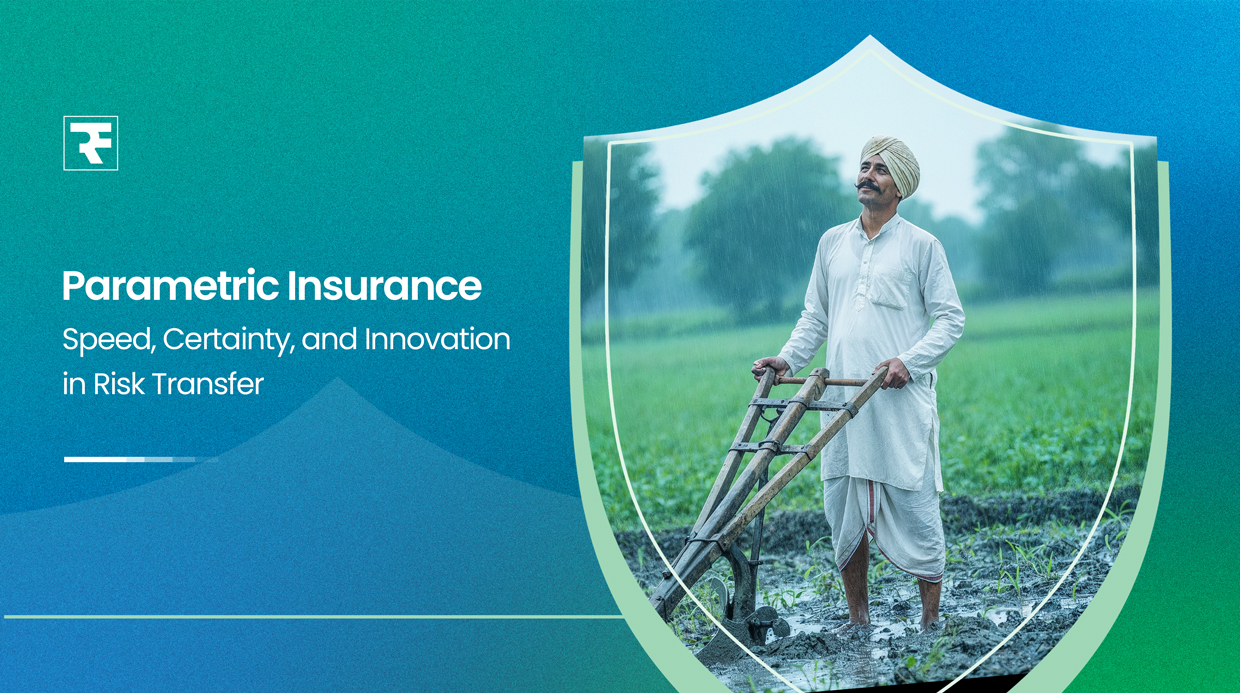
Agricultural Risk Management: India’s agricultural sector presents perhaps the most compelling parametric opportunity. Weather index insurance products based on rainfall measurements, temperature readings, or satellite-derived vegetation indices can protect millions of farmers without the prohibitive cost of individual farm inspections. These products address the fundamental challenge of making crop insurance accessible and affordable at scale.
Business Interruption Innovation: Parametric approaches transform business interruption coverage by focusing on objective operational metrics rather than financial loss calculations. A hotel chain might purchase parametric coverage that pays based on rainfall exceeding thresholds during peak season, regardless of actual occupancy impact. A solar energy producer might secure coverage based on sunshine hours falling below historical averages, providing revenue certainty without complex business interruption calculations.
Supply Chain Resilience: As supply chains grow more complex and interdependent, parametric solutions offer new risk management tools. Coverage can trigger based on port congestion indices, shipping delays exceeding thresholds, or supplier facility disruptions confirmed through public data sources. These products provide rapid liquidity to manage supply chain crises without waiting for ultimate financial impact determination.
The Basis Risk Challenge
Parametric insurance’s primary limitation stems from basis risk—the potential mismatch between trigger events and actual losses. A rainfall index might indicate normal precipitation while localized flooding damages a specific facility. Conversely, triggers might activate when a business experiences minimal actual loss. This gap between parametric triggers and indemnity-based losses requires careful product design and realistic expectations.
Sophisticated parametric programs address basis risk through multiple approaches:
- Granular Triggers: Using location-specific data and multiple parameters to better correlate triggers with actual exposure
- Tiered Payments: Structuring payouts that increase with trigger severity, better matching potential loss patterns
- Hybrid Products: Combining parametric triggers for rapid initial payments with traditional coverage for ultimate loss settlement
- Customized Design: Tailoring triggers to specific client operations and risk profiles rather than standardized products
Market Evolution and Indian Opportunity
The global parametric insurance market has grown substantially, with estimates suggesting a market exceeding several billion dollars and continuing rapid expansion. Caribbean nations pioneered sovereign parametric programs for hurricane and earthquake protection. African countries developed agricultural parametric schemes serving millions of smallholder farmers. Asian markets increasingly adopt parametric solutions for natural catastrophe and agricultural risks.
India’s diverse risk landscape presents exceptional parametric opportunities. Agricultural applications alone could serve hundreds of millions of farmers currently lacking adequate crop insurance. Infrastructure development creates demand for construction delay coverage. Growing manufacturing and services sectors need business interruption solutions that provide certainty in recovery planning. The Insurance Regulatory and Development Authority of India has shown openness to innovative products, creating regulatory space for parametric development.
Strategic Implementation Considerations
Organizations considering parametric insurance should approach it as a complement to traditional coverage rather than a replacement. Parametric products excel at providing rapid liquidity and covering specific, well-defined exposures. Traditional insurance remains superior for comprehensive loss indemnification and complex claim scenarios.
Effective implementation requires careful trigger design balancing accuracy, simplicity, and data availability. Overly complex triggers may reduce basis risk but create disputes over data interpretation. Overly simple triggers may activate inappropriately or miss significant losses. The optimal design depends on specific risk characteristics, available data sources, and organizational risk tolerance.
Future Outlook: Expanding Horizons
Parametric insurance’s future trajectory points toward broader applications and greater market penetration. Climate change increases natural catastrophe frequency and severity, driving demand for rapid-response coverage. Digital transformation generates new data sources enabling parametric products for previously uninsurable risks. Financial markets’ growing interest in insurance-linked securities provides capacity for parametric program expansion.
Emerging applications include cyber event parametric covers triggered by specific attack types or system outages, pandemic parametric products activated by infection rates or government restrictions, and operational parametric solutions for diverse business interruptions. As data availability improves and market sophistication increases, parametric insurance will likely evolve from specialty product to mainstream risk management tool.
Conclusion: The Future of Risk Transfer
Parametric insurance represents more than an innovative product category—it embodies a fundamental rethinking of insurance’s role in risk management. By prioritizing speed and certainty over precise loss measurement, parametric solutions transform insurance from backward-looking compensation into forward-looking business resilience. For Indian businesses navigating increasingly complex and rapidly evolving risk landscapes, parametric insurance offers powerful tools for building operational resilience and financial stability in an uncertain world.
ADVT/RIBPL/2025-26/75 | Ratnaafin Insurance Broking Private Limited | CIN: U66000GJ2019PTC110264 |
Registered Office: 201, 202 – Shilp Aperia, Nr. Landmark Hotel, Iscon Ambali Road, Bodakdev, Ahmedabad, Gujarat, India, 380052 |
IRDAI Broking Registration No.: 724 | License Category: Direct Broker (Life & General). Valid till 05.07.2026
For more details on risk factors, terms and conditions, please read sales brochure carefully before concluding sales.